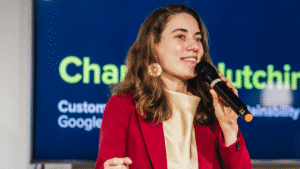
Clare Forestier, MC and speaker and Richard John of Realise, have come together to author a new white paper that takes a look at speakers within the events industry – ‘Behind The Mic: A definitive guide to onstage roles and competencies at events‘.
Choosing the right speaker for an event, meeting or conference, can be a real challenge. Not only is it a matter of finding someone who is knowledgeable, but also ensuring you choose someone who fits the role. There’s more to it than finding someone to stand in front of an audience and share their insights and expertise.
In the introduction of their new white paper, it says, “Our goal is to establish a definitive event industry standard that fosters consistency, professionalism, and excellence in B2B events – whether in-person or remote”. It goes through topics such as understanding the different roles and selecting talent.
In this Q & A, Clare and Richard expand on that introduction and share their thoughts on why their new white paper is needed.
Q. What was the motivation behind the white paper and how did the collaboration come about?
Clare – It really started as a conversation between the two of us; both sharing frustrations about the confusion and inconsistency in how on-stage roles are described and used at B2B events. Clare had noticed, particularly in her work as an MC, that terms like “moderator,” “facilitator,” and “host” were being used interchangeably, and often incorrectly, which meant expectations were unclear when she arrived on site. She was sometimes doing “translation” work on the day just to align everyone’s understanding.
It also became clear that many speakers didn’t quite know where they fitted into the wider event experience. It all felt a bit siloed. Richard had noticed similar issues and brought his own perspective.
Richard – Companies seem to use the various words totally interchangeably, and also assume that they had the necessary talent in-house. I know from personal experience that I can be an adequate speaker, and a troublesome panellist, but I’m rarely much use as a Chair – because only my opinion matters!
Clare – Instead of just having a moan, we decided to actually do something about it. The result is a white paper aimed at promoting consistency, clarity, and professionalism in how event talent is selected and used.
Q. What does consistency, professionalism, and excellence look like in B2B events?
Clare – From an audience perspective, it’s about knowing what to expect – and then delivering on that. From an organiser’s perspective, it’s about choosing the right people for the right roles, based on skills and purpose, not just who’s available or who’s paid to be there.
Richard – And it’s about agreeing this common language, and thinking ‘what do I want this session to achieve?’ From there the right skills on stage can be agreed.
Clare – So much confusion in events comes from assuming we all mean the same thing by words like “facilitator” or “keynote,” when actually we don’t. And that’s where disappointment and disconnect creep in: not because someone’s not good, but because the role wasn’t properly understood or defined.
Q. Are speakers being chosen for ability or popularity, and is that a problem?
Clare – This is something we see more and more. Speakers are often booked because they have a strong social media following or because they’ve been described as an expert in a certain field. That’s not necessarily a bad thing, but it can lead to mismatches if they can’t deliver live.
We’ve both had conversations where organisers say things like “we’re bringing in this guy – apparently he’s big on LinkedIn.” But when you ask whether they’ve seen him speak, the answer is often no. Social clips can be edited to look great, but can they hold a room for 30 or 40 minutes? Can they connect with a live audience? Sometimes, organisers are clearly hoping for the best.
Our view: don’t rely on online profiles alone. Ask for testimonials. Arrange a chat. If someone can’t even manage a decent Zoom conversation, chances are they’ll struggle on stage.
Richard – Also, even the best Speaker needs to be curtailed so that the audience can be given the opportunity for real Q & A, and to find out ‘how does this apply to me?’ Otherwise, if there’s no change, what’s the point?
Q. Is there more that needs to be said?
Clare – Absolutely. Even basic terms like “workshop” mean different things to different people. For Richard, it implies a small, collaborative session. For me, it can be that, or something larger if it’s been properly structured with breakout activity and support.
But again, it all comes down to being clear on what’s expected and who’s best placed to deliver it. Being a subject matter expert doesn’t automatically make you a great workshop leader. You need the kind of presence and flexibility it takes to keep a whole room of people actively listening and involved.
Richard – Also, using the right event title can deliver a self-selecting audience. For example, it’s now the ‘Davos Forum,’ not ‘conference.’
What are your top tips for speakers?
Clare – A big one here is: get involved early. The best event experiences happen when speakers understand the wider context of the event, not just their 30 minutes on stage. It’s not just about delivering a standalone talk; it’s about contributing meaningfully to the whole.
Event organisers should always try to connect speakers with each other, AND with other contributors like the emcee, ahead of time. And as a speaker, you should be asking:
- What’s happening before and after my session?
- How does my topic build on or complement others?
- Who else is speaking, and how can I support or reference them?
The most memorable speakers we’ve seen make an effort to attend other sessions, or at the very least, get properly briefed on what’s happening. They can then say things like “as you heard earlier…” or “building on tomorrow’s session…” and that makes a huge difference. It shows that the speaker is part of something bigger, and not just parachuted in for a slot.
When organisers and contributors are all part of an effective team, it creates a sense of community backstage; a shared purpose, shared knowledge. And that atmosphere absolutely pays forward into the experience for the audience. The event starts to feel less like a string of isolated moments and more like a cohesive gathering of minds.
And really, that’s what we all want an event to become: a temporary community of ideas, energy and insight. That only happens when everyone is working together to create something joined-up.
So, our advice to speakers:
- Ask to be properly briefed.
- Learn about the wider event.
- Meet the other contributors if possible.
- Be part of the team, not just a guest slot.
- Look for ways to add extra value.
The more collaborative we all are, the better the event, for the audience, for the organisers, and for the speakers themselves.
Richard – I totally agree. I bang on about the ‘afters’, what do we want to happen AFTER the event. What do the audience need to feel, think and do differently to create change. That’s what speakers should demand to know.
Big thanks to Richard John and Clare Forestier for taking part.