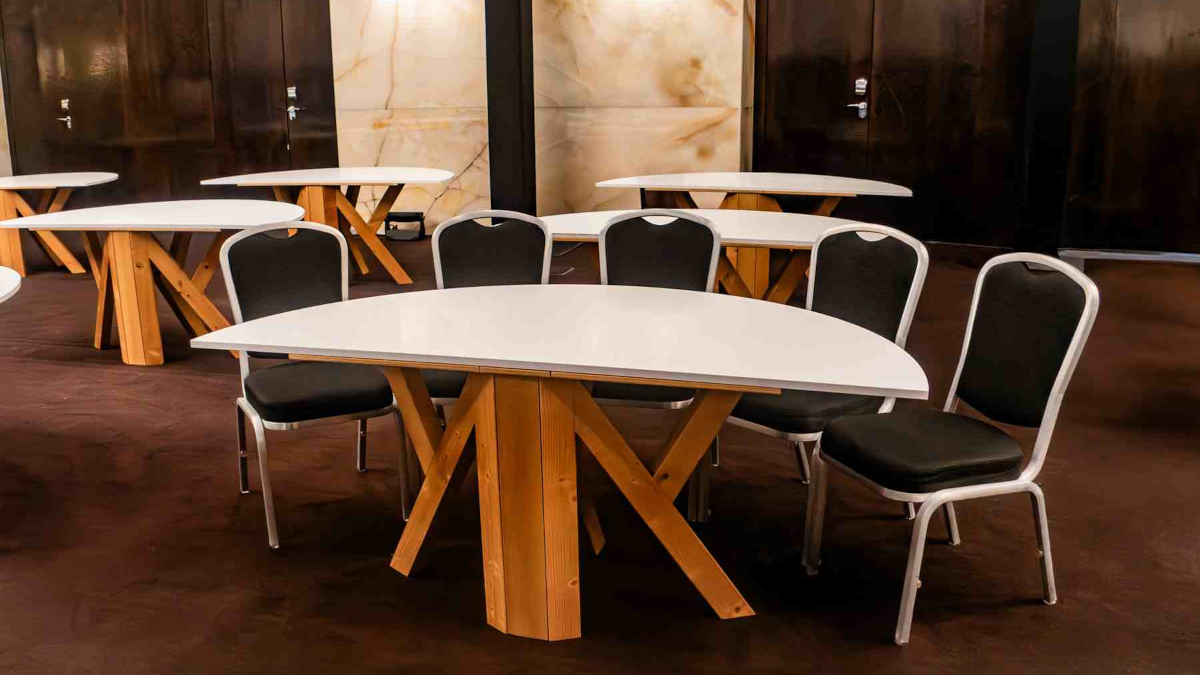
We spoke with Pedro Magalhães, CEO and Founder of the Portuguese company Europalco, the largest provider of solutions for events and shows in Southern Europe. We discussed how a recurring issue at gala dinners and corporate conventions, guests seated with their backs to the stage, led to the development of the company’s new half-moon table format.
The half-moon table is a simple idea, but it addresses a very specific challenge. How did it come about?
It came directly from what we were seeing in the field. In events that combine dinner with a stage program — gala dinners, corporate conventions, award ceremonies — there’s a recurring issue with traditional round tables: around half of the guests are seated with their backs to the stage.
Throughout the evening, people turn their chairs to follow presentations or performances. It’s a small detail, but it affects comfort, attention and the overall experience. We wanted to find a solution that preserved the atmosphere of shared dining while ensuring everyone had a clear line of sight to the stage. That’s how the half-moon format was born.
What makes the half-moon layout different from other seating solutions used in banquet-style events?
The difference is in the balance. Theatre-style seating guarantees visibility but removes the dining experience. Traditional round tables create interaction but compromise sightlines.
By dividing a round table into a semi-circular format, we keep the proximity and social dynamic of a dinner table while aligning every guest toward the focal point of the room. There are no blind angles and no one seated with their back to the action. It’s a small structural change with a significant impact on how the event feels.
From a practical standpoint, what are the specifications event planners should know?
Each half-moon table accommodates approximately five guests, making it suitable for both mid-sized and large-scale events. The tables measure 180 x 90 x 72 cm and weigh around 30 kg, which makes them manageable for installation while remaining stable during service.
They feature a white melamine top with an aluminium structure as standard. While white is the most requested finish due to its versatility, we can provide alternative colours or apply vinyl branding to align with a client’s visual identity.
Have you already implemented the tables at live events? What has the feedback been?
Yes, we’ve used them in several corporate events and gala dinners. The feedback has been very positive.
Organisers appreciate the more efficient use of space and the flexibility in layout design. Guests notice something even more immediate: they can follow the program naturally, without constantly adjusting their position. It creates a more relaxed and attentive environment.
You also mention space efficiency. How does the format improve room layout?
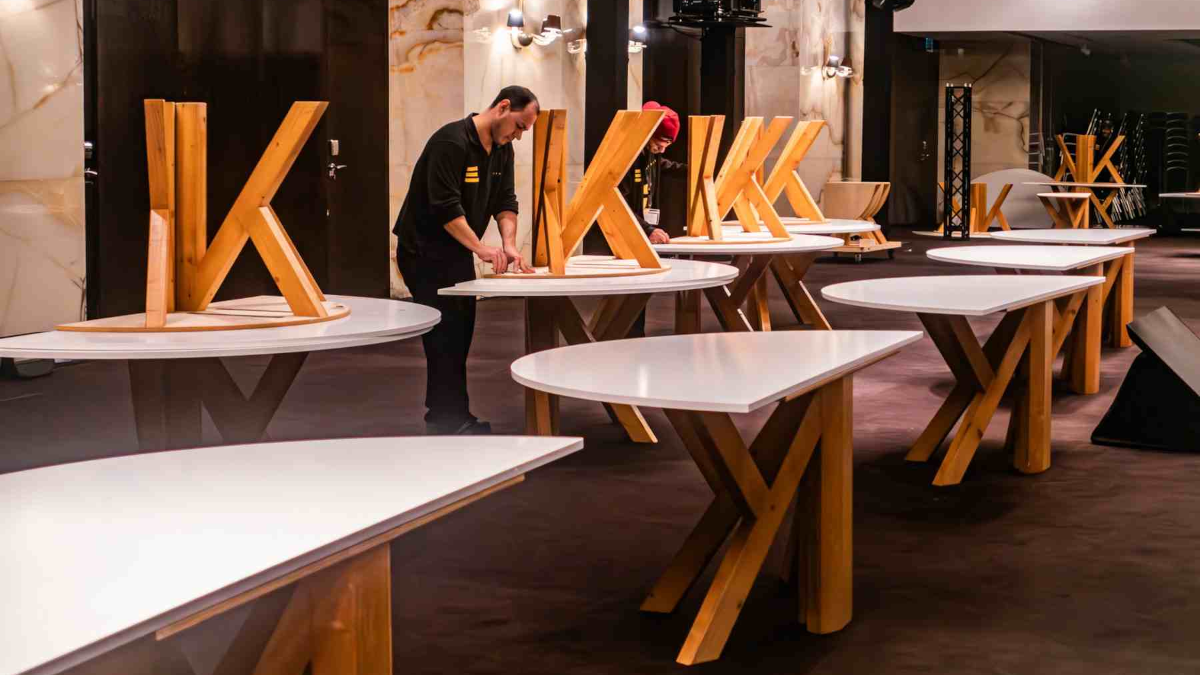
A half-moon table occupies less floor area than a full round table. This gives us greater flexibility when designing the room. Circulation improves, technical areas are easier to integrate, and in some venues it allows us to increase overall capacity without compromising comfort.
For production teams, this flexibility is extremely valuable, especially in venues with structural constraints or limited dimensions.
Are these tables an external product or something developed in-house?
They are entirely developed and manufactured in-house by our carpentry department. That’s important for us because it allows us to respond quickly to project needs and maintain full control over quality and production capacity.
We keep our own stock and can equip large-scale events serving hundreds of guests.
Can the tables be customised?
Yes. The standard finish is white, which works well in most corporate and gala environments, but we can adapt colours and apply vinyl branding when required.
Since the tables are produced internally, we have flexibility to align them with the aesthetic identity of each event.
Do you see this as part of a broader shift in how event seating is being approached?
What we see is increasing attention to detail in event design. Clients are more aware that small layout decisions influence engagement and perception.
The half-moon table is not about reinventing furniture — it’s about refining how a space functions. When every guest faces the stage, the room immediately feels more intentional and connected. Sometimes innovation in events isn’t about adding more technology; it’s about solving practical problems in a smarter way.
Huge thanks to Ignacio Fossati for his contributions to this article.