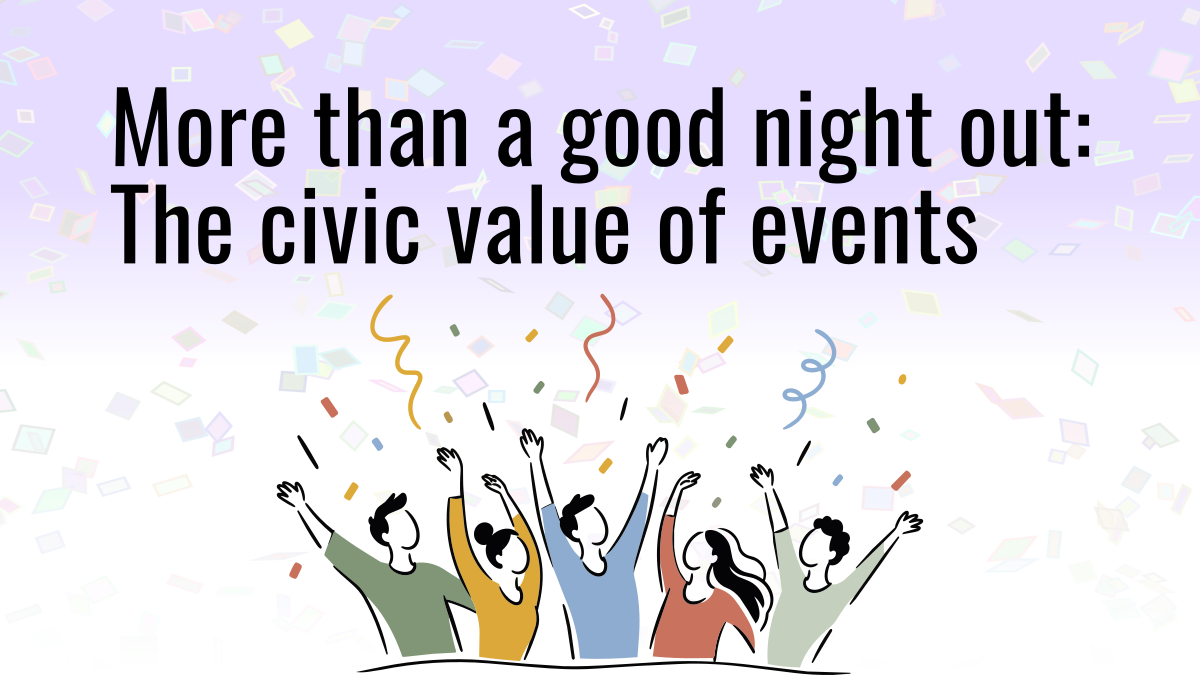
Ask most people what an event is worth and they will talk about money: ticket sales, hotel nights, supplier contracts. Those figures matter, and the sector is right to count them. But they describe what an event earns, not what it does for the place that hosts it. That second question is about civic value, and two pieces of research I have worked on recently highlight that it deserves far more attention than it gets.
Events build the places we live in
Civic value is the contribution an event makes to community life: belonging, shared identity and local pride. Think of a town’s lights switch-on, a food festival, a Remembrance parade, a Pride march or a village fete. These are among the few occasions when people who would never otherwise meet share the same space for the same reason. That is social infrastructure, and events professionals have been building it for years, even though it’s rarely referred to in that way.
The Value of the UK Outdoor Events Sector, which I wrote earlier the year for the Purple Guide with John Gallery and The Power of Events, puts the economic headline at no less than £25bn a year in direct value, with a total impact that could reach £50bn. Yet when we ran focus groups with over 100 professionals, the benefit people raised most often after employment was bringing communities together.
Value that’s hiding in plain sight
Some of the clearest civic examples are the ones standard measures miss. Notting Hill Carnival and Derry Halloween are free to attend, yet published estimates put their impact at £396m and £3m respectively. Gwyl Fwyd Caernarfon drew 42,000 visitors in a single day on organiser turnover of just £70. Measure only what the organiser earns and events like these look like nothing. Measure what they bring to the town and the picture changes entirely.
Social value is harder still. Hijinx Unity Festival in Cardiff was assessed at £4.84 of social value for every £1 invested. Wellbeing, social connection and the animation of underused public space came up again and again in our research, but we found no consistent way of evidencing them. What cannot be evidenced is easily dismissed when budgets are ever tighter so we have a problem in articulating this kind of value.
The people behind the scenes
Outdoor events run on volunteers, stewards and community groups giving their time. We identified more than 20,900 volunteers across the 537 events we mapped, and their contribution is largely missing from economic accounts altogether. Participants described burnout, weak succession planning and difficulty recruiting as real risks. If an event depends on goodwill, then goodwill is part of its infrastructure and needs looking after as such.
Volunteering is also where many careers begin. It builds skills, confidence and networks, and for many young people it is a first step into work. The Power of Events’ Experience of Work programme shows how that can be made deliberate rather than accidental, connecting students to the vibrant and growing events sector that they may never have realised existed before.
Planning for place
This is why the events strategy work I carried out with Ivna Reic for West Northamptonshire Council matters to me. The project combined market research, benchmarking and an audit of the area’s events, alongside a resident consultation asking what events people want to see, what stops them attending and how events could better reflect local communities.
The council framed its aims around community, civic pride, economy and place, and committed to a community-led approach with local insight, academic research and student involvement. In other words, a local authority starting from what events are for, and who they are for, before asking what they cost.
Fragile assets
Civic assets can disappear. The Purple Guide research recorded 592 music festivals in 2025, down from a peak of 800 to 900, with 249 closures since 2019. Leicester Diwali, which generates around £3.5m of local economic contribution from roughly £250,000 in organiser costs, is being scaled back because of rising costs. When events go, the community occasions that sit alongside the economics go with them.
Safety belongs in this conversation too. Licensing, crowd flow and welfare provision exist because communities need to trust that gathering together is safe. Protect that trust and people come back; break it and the damage reaches well beyond a single event.
Measuring what matters
No one has yet counted every outdoor event in the UK, and there is no sector-wide standard for measuring their value. Frameworks such as eventIMPACTS help by looking at visitor and organiser spend together, but social, wellbeing and placemaking value still lack consistent tools. If we only measure what is easy to measure, we will keep undervaluing what communities value most. Graduates who can evidence social value, not just economic impact, will help the sector make its case to funders and policymakers.
So here is the question to take away. If events are civic infrastructure, why are they so rarely planned, funded and evaluated as if they were? And what would change if every event brief began by asking what this is for the place that hosts it?