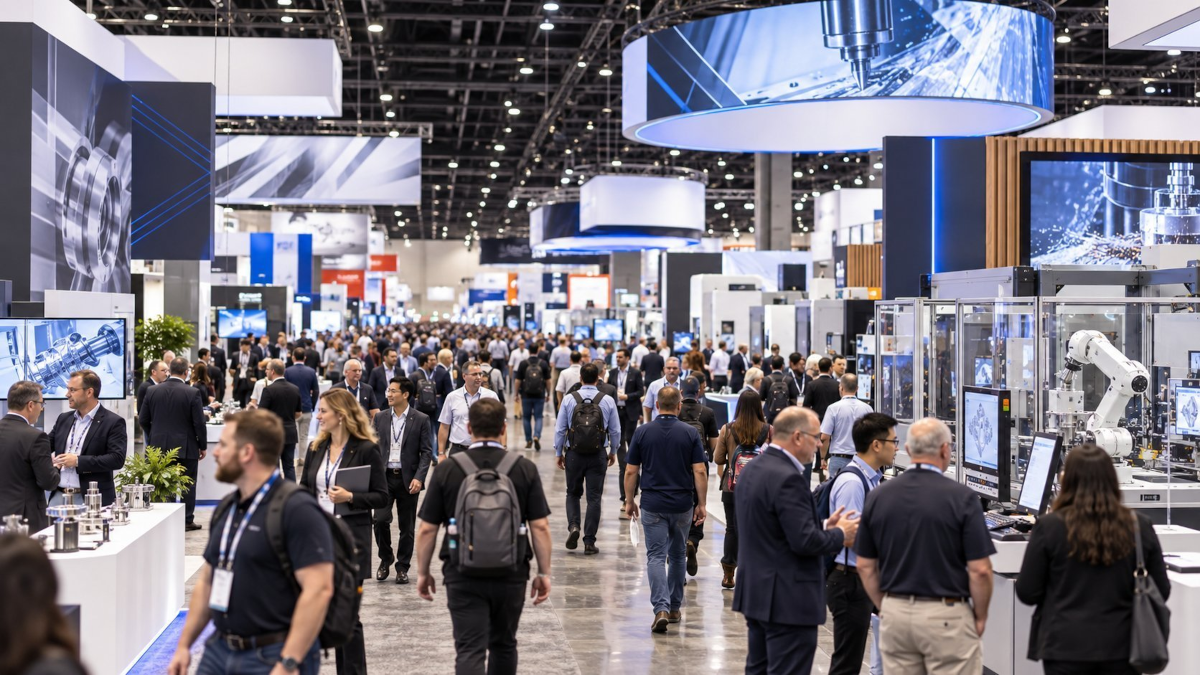
IMTS 2026, The International Manufacturing Technology Show, brought more than 90,000 registrants, 1,788 exhibiting companies, and visitors from all 50 states and 113 countries to McCormick Place in Chicago. Across roughly 1.17 million square feet of exhibit space, attendees explored machining, automation, robotics, additive manufacturing, artificial intelligence, software, metrology, tooling, connected systems, and other manufacturing technologies.
Those numbers tell you something about the scale of IMTS. But the more interesting story is what happened inside all that space. Visitors arrived with real production challenges. Exhibitors demonstrated practical solutions. Conversations became action plans, relationships were strengthened, and manufacturers compared technologies and explored investments. In other words, IMTS wasn’t simply a technology showcase. It was a marketplace for solving problems.
That distinction matters for anyone involved in B2B trade shows. As products become more sophisticated and business decisions more complex, the value of an event isn’t simply putting a product in front of a large audience. It comes from bringing the right people, technology, information, and conversations together in one place.
Douglas K. Woods, president of AMT (The Association For Manufacturing Technology), described manufacturing as “a community of people who make things and solve problems.” He also emphasized that the real measure of IMTS would be what happened afterward: the investments manufacturers make, the technologies they put to work, and the relationships they build. That’s a useful way to think about trade shows in general. The event itself is only one part of the process.
The Exhibit Is Becoming Part of the Customer Journey
Traditionally, the word “booth” describes the physical space an exhibitor occupies at a trade show: the structure, graphics, lighting, products, demonstrations, meeting areas, and branding on the show floor. That definition still works, but it no longer captures everything an effective exhibit needs to accomplish. The modern exhibit is more than a booth. It is part of a connected sequence of content, experience, conversation, and follow-through.
Today’s buyers are often well informed before they ever arrive at an event. A prospective customer may have already encountered a company through search, social media, email, a sales call, a webinar, an industry publication, digital content, or a previous event. By the time that person walks into the booth, the physical experience may be several steps into the relationship rather than the beginning of it.
The exhibit needs to continue that conversation. Messaging should reinforce what visitors already know while giving them something they cannot get from a website or brochure. Booth staff should be ready to move beyond general information into meaningful discussions. And when a visitor leaves, there should be a clear reason and mechanism to continue the relationship. That’s why exhibit strategy can’t be separated from content, sales, event marketing, demonstrations, technology, staffing, and post-show follow-up. They are different parts of the same customer journey.
The Power of Demonstration
IMTS also reinforces an important principle for companies selling sophisticated B2B products and technologies: one of the strongest forms of proof is still a live demonstration that connects the technology to the larger workflow. That is particularly relevant in manufacturing because most technologies don’t operate in isolation. A machine exists within a production process. Automation interacts with equipment and people. Software connects systems and data. Robotics changes how materials move. Artificial intelligence increasingly becomes part of larger production and decision-making processes.
Often, the real value isn’t found in one piece of technology. It’s found in how those technologies connect. That can be difficult to communicate through graphics or brochures. Video can explain a great deal, but it still asks the viewer to translate what they’re seeing into their own operation. A well-planned live demonstration closes some of that gap. Visitors can see how a system operates, ask questions in the moment, and understand not only what a product does but where it fits and why it matters. For complex or high-investment purchases, that’s a critical shift. The conversation moves from “What is this?” to “How would this work for us?” That’s a far more valuable conversation.
The Workflow Is the Story
One of the challenges facing exhibitors today is that technology itself is not always enough to differentiate an experience. Artificial intelligence is a good example. It’s easy to say a product uses AI. It’s much more useful to demonstrate where AI fits into an operation, what problem it addresses, and what changes as a result. The same principle applies to automation, robotics, software, digital manufacturing, and connected systems. Buyers want context. They want to understand integration, implementation, training, operator experience, and practical outcomes. They want to know how a technology fits into the larger workflow rather than simply hearing a list of features.
That’s one reason an event like IMTS works so well as a physical experience. McCormick Place becomes an environment where visitors can see technologies side by side, compare different approaches, and better understand the relationships between systems. For exhibitors, there’s an important lesson here: don’t just demonstrate the product. Demonstrate the problem, the process, and the role your solution plays within it. The workflow is often the better story.
Human Connection Still Drives the Experience
As technology becomes more sophisticated, it might seem logical that trade shows would become increasingly automated and digital. In practice, the opposite can also be true. The more complicated the technology becomes, the more valuable a good human conversation can be. A visitor may see a demonstration and recognize a challenge in their own operation. An engineer may want to discuss integration. An executive may want to understand the business case. An operator may have entirely different questions about implementation or usability. Those conversations are difficult to script, which is exactly why they matter.