In events, the post-event debrief has a reputation problem. Too often, it is treated as a box to tick: a quick conversation over coffee before everyone disperses. And the honest truth is that time and resources rarely allow for anything more. The hot debrief happens because it has to, but he deeper evaluation rarely gets the space it deserves.
But for practitioners who are serious about developing their craft, and for organisations that need to make a credible case to funders, local authorities, and communities, that deeper evaluation is not optional. It is essential.
David Kolb’s experiential learning cycle (1984) offers a useful framework for understanding why this matters. The cycle moves through four stages: a concrete experience, reflective observation, abstract conceptualisation, and active experimentation. In plain terms: you do something, you step back and examine what happened, you draw conclusions, and you try again with greater insight. Without that middle step, you simply repeat the same experience without learning from it.
Stage 1: Concrete experience
Delivering the event itself.
Stage 2: Reflective observation
Stepping back to examine what actually happened.
Stage 3: Abstract conceptualisation
Drawing conclusions and building understanding.
Stage 4: Active experimentation
Applying those insights to the next event.
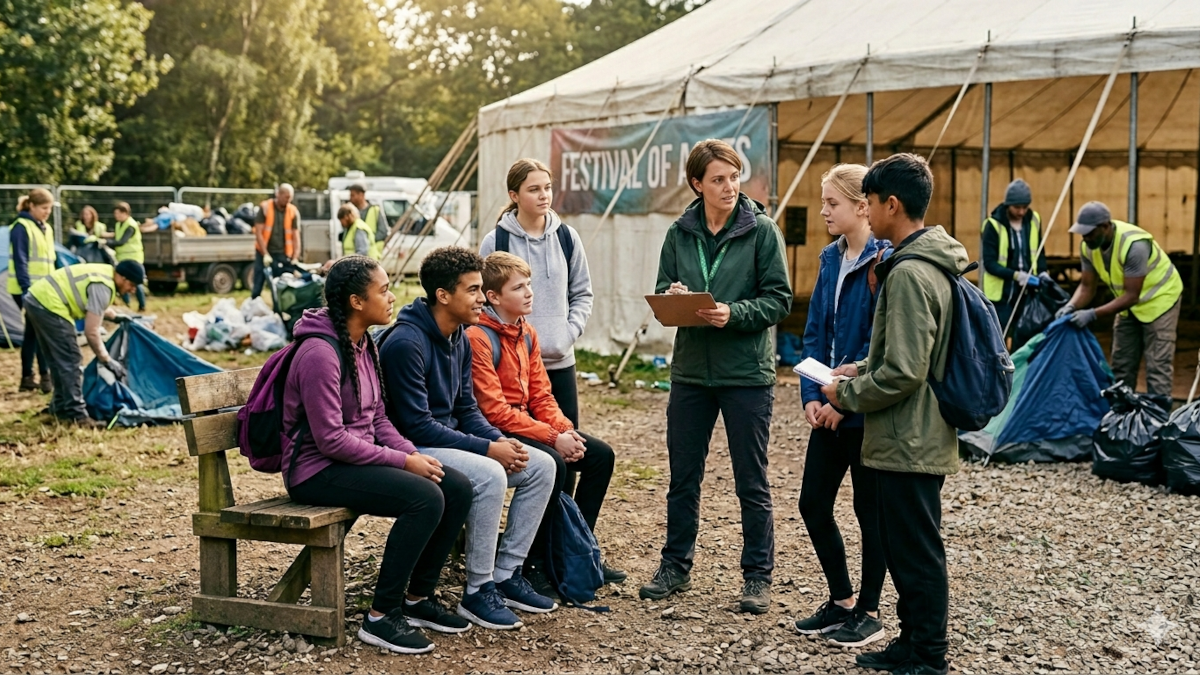
This applies to every event, not just the high-profile or professionally managed ones. Volunteer-led community events, local festivals, grassroots gatherings: these are often where the richest learning lives, and where the evidence of impact is most urgently needed. Yet vast areas of our industry remain largely invisible. The contribution of volunteers alone, in hours, skills, and community value, is rarely captured in any systematic way. We know it is significant. We simply cannot yet prove it at the scale the argument requires.
This is precisely the gap that work like the Purple Guide’s forthcoming report on the Value of the Outdoor Event Sector is beginning to address. Launching on 19 May, the report is an important step towards understanding the true scale and worth of a sector that has long been under-measured. It is a reminder that evaluation is not just a professional development tool. It is an act of advocacy. When organisations seek funding, apply for licences, or make the case for support from local government, they need data, stories, and evidence of what their events actually achieve. A culture of evaluation across all events, at every scale, is what builds that case over time.
The challenge is that not everyone finds reflection natural. Some practitioners instinctively debrief everything; they replay decisions, interrogate outcomes, and look for patterns without being prompted. Others move straight to the next task the moment an event closes. Neither tendency is a character flaw. But the difference in professional development between the two, over time, is significant.
That is why evaluation cannot be left to chance or personal inclination. It needs to be built into project and event planning from the outset. For individuals looking to develop the habit, a few practical starting points make a real difference:
| Keep a reflective log Note three things after every event: what worked, what did not, and what you would do differently. Even five minutes counts. | Ask better questions Move beyond “did it go well?” to “did it achieve what it was designed to achieve?” Outcome-focused questions surface learning that satisfaction scores miss. |
| Seek feedback from all directions Attendees, volunteers, suppliers, and colleagues each see a different event. Gather views from across that spectrum, not just from one group. | Build in the time Schedule evaluation time as part of the project plan, not as an afterthought. If it is not in the timeline, it will not happen. |
For those who do not yet think of themselves as natural reflectors, the good news is that this is a learnable skill. The individual benefits are tangible – clearer self-awareness under pressure, faster professional development, stronger confidence in decision-making, and a track record of improvement that is visible to employers and clients alike. Practitioners who reflect consistently tend to be the ones who grow fastest, not because they are more talented, but because they treat every event as a source of evidence about their own practice.
When senior practitioners model reflective behaviour openly, it signals that this is part of the job, not an add-on for the especially diligent. And when organisations build evaluation into their structures from the start, they create something more valuable than a report: they create a culture that knows how to get better. The goal is not to produce a perfect post-event document for every community event. It is to embed a habit: proportionate, purposeful, and woven into how we work rather than bolted on at the end when everyone has already gone home.