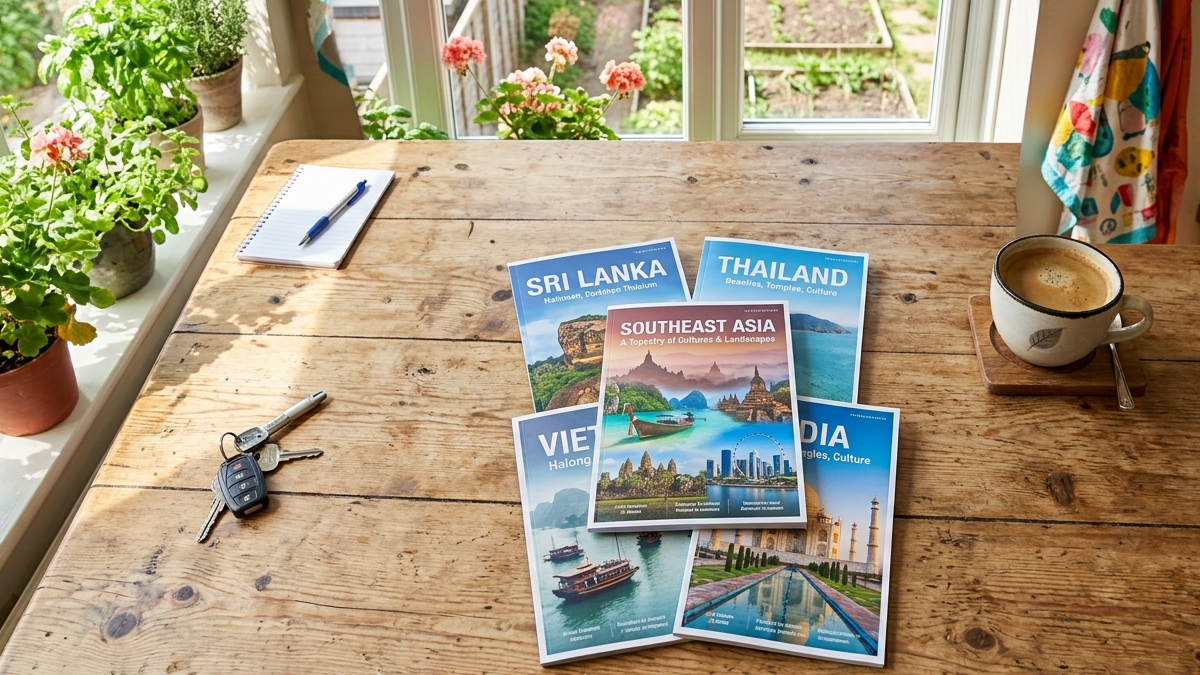
I want to try something in this column. Before you read another word, picture an incentive brochure for a destination described as ‘exotic’. I’ll wait.
You’re picturing a temple at sunrise. Maybe a tuk-tuk mid-blur through a market street. A spice stall, colours arranged just so. And somewhere, always, an infinity pool looking out at something green.
You didn’t have to picture a specific country to picture those four photos. That’s the joke, and it’s on all of us, mine included. Because whether the brochure is for Sri Lanka, Vietnam, Cambodia, or half of Southeast Asia, it’s often the same four images with the labels swapped. We’ve built an entire visual shorthand for “somewhere far away and a bit thrilling,” and it has almost nothing to do with the destination underneath it.
Here’s what nobody says out loud in our industry: Those four photos are easier to source than they are to earn. A stock library will hand you a sunrise temple in under a minute. Getting a client to a moment that’s actually theirs, the one nobody else’s brochure has, takes longer, costs more effort, and doesn’t always survive a template.
So the brochures default to the template. And planners, quite reasonably, start to read “exotic” as a genre rather than a place: Interchangeable, slightly risky-sounding, safe to file under “someday” rather than “this year.” The stock photo isn’t just lazy. It’s quietly doing the work of making a destination forgettable at the exact moment it’s meant to be persuasive.
I don’t think the fix is a fifth stock photo. I think it’s admitting the first four were never doing anyone any favours, including the countries in question, which tend to be a great deal more specific and a great deal less symmetrical than a marketing template allows for. Japan’s incentive appeal has nothing to do with a tuk-tuk. Sri Lanka’s has nothing to do with Angkor Wat. India alone contains enough regional difference to make “temple at sunrise” a genuinely meaningless descriptor: Which temple, whose sunrise, in a country with two dozen distinct culinary and cultural regions.
If there’s a provocation in this column, it’s a small one: The next time a brochure for an Asian incentive destination lands on your desk, ask what in it couldn’t be swapped for another country’s brochure without anyone noticing. If the answer is “not much,” that’s not a reflection on the destination. It’s a reflection on how little effort went into showing you the destination at all.
Asia isn’t undersupplied in infrastructure, safety data, or genuine world-class experience: It’s undersupplied in marketing that bothers to be specific. That’s a fixable problem, and it starts with retiring the four photos.