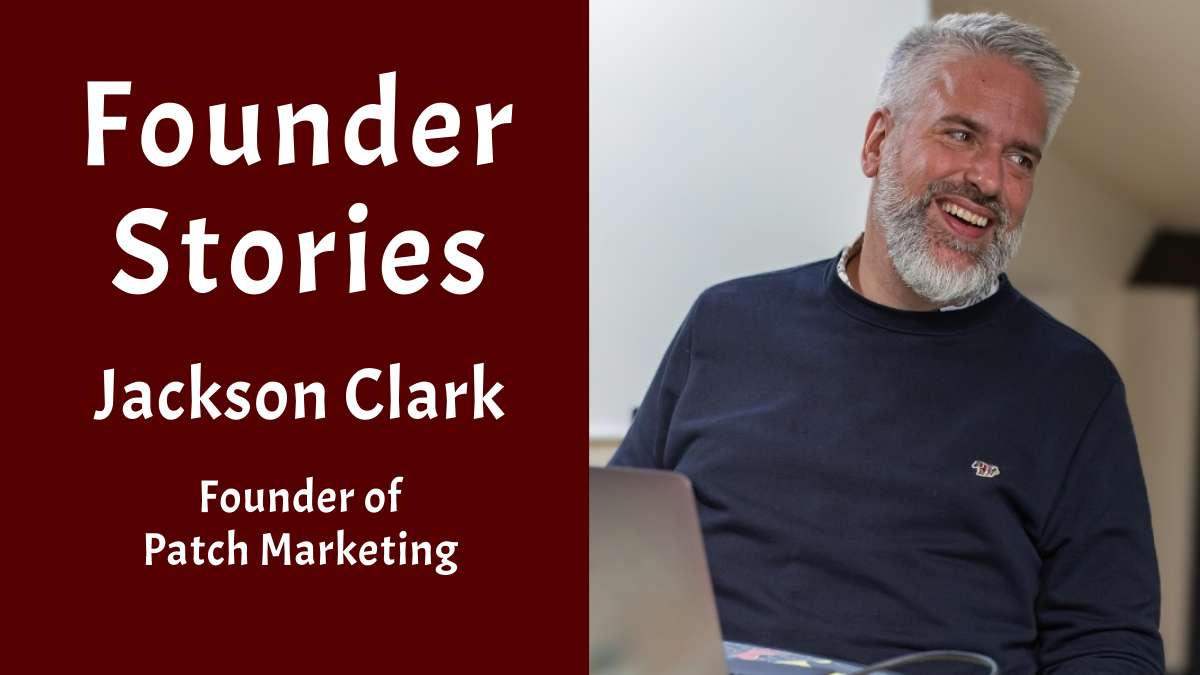
After 15 years, Patch Marketing has become a specialist, full-service marketing agency for the events sector. The journey from Jackson Clark’s initial idea to where the agency stands today tells an inspirational and authentically real story of adaptability, empathy and knowing when to deviate from your original plan.
I didn’t need a mammoth business plan. I didn’t spend months on scenario planning or extensive market research. What I had was simpler and as it turned out, far more valuable. It all started with a clear understanding of a problem that needed solving, enough cash flow for 12 months and the guts to give it a go.
A Seed is Sown
The idea first sparked during my time as Conference Portfolio Manager at Mash Media, helping hotels, destinations and venues find creative and innovative routes to market. Part of my remit involved selling advertising space to media buyers managing substantial accounts, £600,000+ portfolios where business tourism made up just 2% of the spend.
I would nearly always get rate card from these buyers. It wasn’t fair on the venue clients because they’d employed the agency to negotiate preferential rates for them and have their best interests at heart. I didn’t feel that was happening.
That disconnect became the foundation for Patch, which initially launched in September 2010 as a media buying agency specifically for the events and venue sector. But I didn’t just blindly leap, I validated my idea first, speaking with ten venues about the concept. Eight said they’d work with me. Once I made the jump, six of them became my first clients.
A Few Unfounded Assumptions
Like many aspiring entrepreneurs, I had built up certain beliefs about what it would take to launch a business. I assumed I’d need months of detailed business plans, extensive forecasting and comprehensive scenario planning before I could even think about starting.
But when it came to it, I didn’t really do any of them to any great degree. Back of an envelope numbers were sufficient. I knew I had enough cash flow for a year. I knew there was a need for this service. I had an idea, I validated it, I worked out my costs and I cracked on.
I was also really nervous about getting messed around by businesses when it came to paying. But I needn’t have worried so much. Touch wood, to this day, I think we’ve had two bad payers out of thousands of invoices. Most clients are so respectful and will pay within 30 days, regular as clockwork.
The Pivot That Changed Everything
If there’s one thing that defines Patch’s journey, it’s my willingness to evolve based on what clients actually need rather than what I thought they should need.
I’d envisioned the agency growing from business events media buying into leisure tourism and then global leisure media buying. That’s not what happened.
Within six months of launching, I was managing social media for clients and working with partners on SEO. By early 2011, the agency had already moved well beyond its original media buying remit. Today, that initial service makes up just 2-3% of the business. Patch is now a full-service marketing agency offering everything from SEO and paid ads to social content, websites and PR.
I’m not laser-focused on where I think it’s going to go. If clients and the market are telling me something isn’t relevant, I take that on board. I just want to continue solving problems. And what those problems are is driven by the client.
This flexibility and willingness to listen and adapt rather than stick rigidly to an original vision, has definitely been crucial to Patch’s longevity and success.
When It Became Real
The shift from idea to reality came in stages. There was the immediate validation of those first clients saying yes. Then there was a stroke of timing luck when VAT increased from 17.5% to 20% at the end of 2010, and two clients chose to pay their entire 2011 marketing budgets before year-end. While I took a hit on the difference, it gave me crucial cash flow breathing room.
But the real moment came in year two.
Year two was when I had to live off what I was making, so the business had to be working for me. Every month in year two felt like “I’m really doing this.” I got excited when someone gave me £1000 for the year, thinking “that’s another half a month keeping this dream alive.”
By the time I was in a position to move into an office in Farringdon, leaving behind working from home or at my mum’s house, the business was standing on its own two feet.
The Lesser-Known Reality
That first office space? It wasn’t your typical startup story. Patch’s initial Farringdon location was in the back of a hairdressers on Clerkenwell Green, a deal I arranged through friends who were web developers. We’d pay for electricity in exchange for free office space while helping the salon owner get more clients through the door.
On paper, it should have been an incredible experience. In reality, it was utter chaos! This guy would come into our office once a day, eat a whole chicken and two bags of lettuce, then take all his clothes off and lie down to stretch out after his lunch. He made it his personal mission to try and distract us, all day, every day.
I realised the situation had become untenable when I worked from my mum’s for half a day and achieved more than I had in an entire week at the office. Somehow, I managed to run a business in that environment, but we ended up leaving there after six months.
It’s the kind of detail that doesn’t make the final edit in most of these stories; the messy, uncomfortable, bizarre reality of those early days when you’re figuring things out and making it work however you can.
The Mental Game
One of the biggest surprises for me wasn’t about logistics or funding, it was the mental toll of being always “on.”
You hear about entrepreneurs pulling 18-hour days, sacrificing their health and missing important life events. I’ve deliberately avoided that path, maintaining what I consider a healthy setup where I’m not involved in day-to-day delivery and don’t pull those gruelling hours. It’s also something I’ve taken great lengths to instil within our workplace culture.
But it’s still exhausting. No matter what you’re doing, as a business owner you are always on. You’re always in your own head thinking “what if?” Whether someone’s about to leave, or you’re waiting on news to win or lose a client, it’s always there.
Don’t get me wrong, I don’t want to paint this as a bad thing. I feel so lucky to be doing this. I absolutely love it. It’s thinking about something that I love versus being stuck in an environment that I hate but being able to turn off after five o’clock. I just can’t turn that switch on and off.
The Pandemic Paradox
I was once asked if there was ever a moment when I seriously considered giving up, my answer was an immediate: “No.”
Even COVID-19, which devastated the events industry, didn’t break my resolve. In fact, it had the opposite effect. COVID galvanised us. The injustice of it from a business perspective made me angry and therefore more driven than ever.
Those initial two or three weeks when clients had to pause their work were frightening. But Patch was fortunate, some clients kept us on because they valued the work, even though no one knew how long the crisis would last.
From that difficult period came unexpected positives. We shifted to four day weeks at 80% salary, which became a live case study in the benefits of a longer weekend. The practice stuck – I later introduced the 4.5 day working week, finishing at 13:00 on Fridays without any salary reduction. We wouldn’t be doing it today if not for that forced experiment.
We also launched a virtual FAM trip during lockdown, called ‘Virtually London Live’. I’ll never forget the surreality of being dressed in black tie from the waist up and boxer shorts below, guiding venues through presentations to meeting planning agencies. It was weird, but it gave everyone purpose and connection when we desperately needed it.
An Expensive Lesson
Every entrepreneur has that one expensive mistake, a learning experience that cost more than they’d like to admit. For me, it was Octoplus, initially envisioned as a SaaS concept that would help venues upload and update their information across venue listing websites in one go.
I spent nine years trying to bring it to market. Nine years and £50,000 invested, only for it not to happen due to factors outside my control. I wish I’d known then that I was not the guy to lead and project manage a SaaS business to delivery. In hindsight, I should have brought someone else in to lead on it. I couldn’t afford to pay someone £50,000 to work out that it wasn’t going to work in six months rather than nine years, but that would have been smarter.
I couldn’t ever bring myself to fully abandon the idea though, especially when venues kept telling me channel management was an ever-increasing struggle and one of their greatest pain points. Last year, we finally did launch Octoplus, as an audit and content management service, using manual-based processes, but with the same outcomes and results.
The takeaway? Know yourself and surround yourself with the right people. I do that within Patch’s core marketing business, but I didn’t apply the same principle to the software environment, and it cost me.
A Beer with My Past Self
If I could sit down with my younger self on day one, I’d have some pointed advice: “Let’s put some sales targets and clear KPIs in place.”
It might sound like obvious business fundamentals, but in the early days, I ran Patch without those traditional metrics. We won business by having conversations with anyone who wanted one. I focused on creating an environment where everyone can work to their best. But I do often wonder if I could have been more ballsy with decisions.
I know from my own experiences and from talking to other founders, even the successful ones find themselves questioning whether they’ve done enough, aimed high enough, pushed hard enough. I love that I work with great people both within Patch and as clients. But I wonder if there’s a middle ground between selling for the sake of numbers and creating something more financially ambitious.
Since joining the asembl.group, that balance is starting to materialise. We’re now working toward 2030 as a key date for maximising revenue across the group, giving me the framework I’ve been missing while preserving what makes Patch special.
Measuring Success Differently
Perhaps my hesitation around aggressive growth targets comes from my understanding that commercial success isn’t the only kind that matters, or even the most important kind.
When asked what I’m most proud of, my answer doesn’t involve revenue figures or client counts. It’s about the people who have passed through Patch over its 15-year history.
Providing a business that has helped shape people’s career journeys is an incredible feeling. Some of those are still within Patch and others have joined us and then gone off to do something else. Years on, I’m still in contact with them, and they acknowledge the role that Patch played in their career development. That’s delicious.
The second source of pride? Being in business, running an agency for 15 years through some really troubling times, to now find ourselves in the best shape ever in year 15, that’s exceptional.
How It Changed Me
Building Patch changed my professional life, yes, but it’s also fundamentally altered who I am as a person. I’m far more empathetic to people’s personal challenges and emotions. It’s also made me a great deal happier. When you love what you do, that spills into your non-work life in the same way that hating a job would.
I’ve also come to terms with imposter syndrome, that persistent doubt that plagues many entrepreneurs. I’ve dealt with a lot of imposter syndrome over the years with running a business. But I look around now and I’ve realised what my strengths are and I’m really comfortable with that. I see things from other people’s perspectives more than I ever have.
The Simple Truth
My journey with Patch is about simplicity. Not in the sense of “easy”, as nothing about building a business is particularly easy. But simplicity in approach: find a pain point, solve it, talk to people about it. They either want to work with you or they don’t, and that’s fine.
Stay flexible. Listen to what your clients actually need rather than what you think they should need. Build a business where you enjoy the people you work with and create an environment where they can do their best work. Know your strengths and get help for your weaknesses.
And perhaps most importantly, understand that there are different kinds of success. The founders making headlines with eight-figure revenues are one version. But there’s another version that’s equally valid – building something sustainable that lasts for years, helps people develop their careers, serves clients well and brings genuine fulfilment to its founder.
Fifteen years in, through chaos and triumph, weird office spaces and pandemic pivots, I’m still solving problems for the events industry. And I’m still loving every minute of it.